Key Takeaways
- An emergency tree removal call is triaged by risk to people first, then property.
- Utility lines change everything, and the power company must clear the site first.
- Photos, address details, and access notes speed up dispatch more than anything else.
- Storm damage tree removal is priced by risk and complexity, not by tree size alone.
- Documentation gathered on site is what your insurance adjuster will actually want.
- Never approach a fallen tree that is touching, leaning on, or near a wire.
A tree comes down at 2 a.m., the wind is still blowing, and you are standing in your driveway with a phone in your hand. What happens after you dial matters, because an emergency tree removal call follows a specific operational sequence that most homeowners have never seen from the inside.
This article walks through that sequence in order. You will learn what the dispatcher is really asking and why, how crews decide whether to roll immediately or wait for daylight, what happens during the on-site assessment, and how the removal itself is staged. You will also get a clear sense of what drives emergency tree removal cost, what your insurer will expect you to document, and where homeowners most often lose time.
The goal is simple. When something goes wrong with a tree, you should know what to say, what to do, and what to stay away from.
Stage 1: The First Call and What the Dispatcher Needs
The person answering the phone is not making small talk. Every question is a triage question, and the answers determine how quickly a crew is assigned.
Expect to be asked for your exact address and cross street, what part of the property the tree is on, whether anyone is injured or trapped, whether any wires are involved, and whether the structure is occupied. A good dispatcher will also ask whether the tree is fully down or still standing at an angle, because a leaning tree is a live hazard and a down tree is usually a stable one.
If any part of the tree is touching a power line, the answer is always the same: hang up and call your utility and 911 first. No reputable emergency tree cutting service will send climbers into an energized situation. The Occupational Safety and Health Administration treats contact with overhead lines as one of the leading causes of death in tree work, and crews are trained to hold position until the utility de-energizes and clears the site. For detailed safety protocols, refer to OSHA’s guidelines on electrical hazards in tree care.
What to have ready before you dial
- Your address, plus a landmark if the street is blocked
- A short description of what the tree hit
- Photos or a short video taken from a safe distance
- Whether gates, driveways, or side yards are usable for equipment
- Your insurance carrier name, if a structure is involved
Providing these details helps us understand how we prioritize emergency response times. If you are unsure about the immediate steps to take while waiting for help, follow these immediate safety steps.
Stage 2: Triage and the Decision to Dispatch
Not every call becomes a same day tree removal. Companies sort incoming calls into rough priority tiers, and understanding those tiers explains why one neighbor gets a crew in ninety minutes and another gets a morning slot.
| Situation | Typical Priority | Usual Response Window | Why |
|---|---|---|---|
| Tree on house with occupants inside | Immediate | Fastest available crew | Structural and life safety risk |
| Tree blocking the only vehicle exit | High | Same day | Access and egress issue |
| Large limb hanging over a walkway or driveway | High | Same day to next morning | Suspended load can drop without warning |
| Tree down in open yard, nothing struck | Moderate | 24 to 72 hours | Stable, no active hazard |
| Leaning tree with visible root plate lift | High | Same day assessment | Failure is in progress, not finished |
| Any tree in contact with utility lines | Utility first | After utility clearance | Crews legally cannot begin |
This is where conditional thinking helps. If your tree is fully down in the backyard and nothing is damaged, you are almost certainly better off scheduling a normal removal at a normal rate. If your tree is leaning against your roof with the root plate pulled out of the ground, you need a hazardous tree removal crew now, because that load is still moving. Learn to identify the seven warning signs of a failing tree to assess your risk accurately.
Stage 3: The Six-Step On-Site Sequence
Once a crew is dispatched, the work follows a repeatable order. Skipping steps is how people get hurt, so a professional team will move through all of them even when the situation looks obvious.
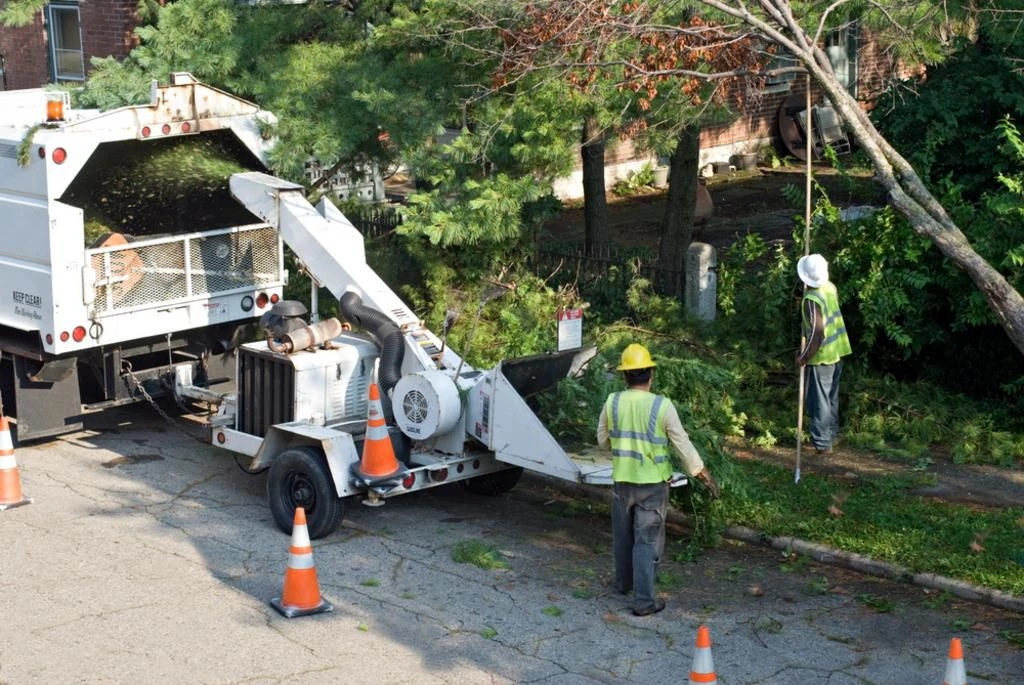
- Scene stabilization. The crew establishes a drop zone, sets cones or caution tape, and moves vehicles and people out of the fall radius. Nobody touches a saw yet.
- Hazard assessment. The lead arborist reads the tree. They look for tension and compression in the trunk, stored energy in bent limbs, cracked unions, hangers overhead, and whether the root plate is still holding. A tree that is leaning on a structure is under load, and cutting it in the wrong order can release that load violently.
- Structural and utility check. If it is a tree on house removal, the crew evaluates what is holding what. Sometimes the tree is the only thing keeping a damaged roof section in place. Service drops, meters, gas lines, septic fields, and buried irrigation all get noted before equipment moves in.
- Plan and equipment call. The crew decides between a straight fell, a sectional dismantle from a climber or bucket, or a crane pick. Access usually decides this. A backyard with a narrow gate rules out a bucket truck and pushes the job toward climbing and rigging. In complex scenarios, we may utilize professional crane assistance to ensure safety and precision.
- Controlled removal. Sections come off in a planned order, rigged and lowered rather than dropped when there is anything below worth protecting. This is the slowest visible part of the job and the part that most directly reflects the skill you are paying for.
- Cleanup and documentation. Debris is chipped or hauled, the site is raked, and the crew photographs the work. If insurance is involved, ask for before and after photos and a written scope description before they leave.
Stage 4: What Drives Emergency Tree Removal Cost
Emergency pricing is not a size chart. It reflects risk, timing, and complexity, and knowing the drivers lets you read a quote intelligently instead of just reacting to the number.
The main factors are proximity to structures, whether rigging or a crane is required, access constraints, time of day, storm demand across the region, and disposal volume. A modest tree resting on a roof can easily cost more than a much larger tree in an open field, because one requires a rigged dismantle over something breakable and the other does not.
For a detailed look at local pricing factors, review our breakdown of emergency removal costs in Doylestown.
If your tree fell into an open yard and nothing is damaged, waiting until normal business hours will almost always cost less. If it is on your roof, or blocking your driveway, or hanging over where your kids walk, the after-hours premium is buying you risk reduction, not just speed.
Pros and Cons of Calling for Immediate After-Hours Service
Pros
- Removes an active hazard before it causes secondary damage
- Allows tarping and weatherproofing before the next rain
- Restores access to your home and vehicles
- Produces timely documentation for your insurance claim
Cons
- Costs more than scheduled daytime work
- Night conditions limit what can safely be done, so some jobs get partially completed
- During regional storm events, availability is genuinely constrained
- May require a second visit for stump grinding and final cleanup
Do and Don’t: The First Thirty Minutes
Do
- Get everyone out of the affected part of the house
- Assume every downed wire is live and stay at least thirty feet back
- Shut off electricity to the damaged area if you can do it safely from a dry, unaffected panel location
- Photograph everything from multiple angles before anything is moved
- Call your insurance carrier and open a claim number. To help you navigate the insurance claims process, ensure you have your policy number ready.
- Ask any company you hire for proof of liability and workers compensation coverage
Don’t
- Climb on the roof to inspect damage
- Try to cut a limb that is under tension with a homeowner chainsaw
- Move debris that is supporting a leaning section
- Sign a blank work authorization or an open-ended contract
- Hire a door-knocking crew after a storm without verifying credentials
The Tree Care Industry Association and the International Society of Arboriculture both maintain credential and accreditation directories that let you verify a company or an individual arborist quickly, even from your phone in the driveway. You can verify arborist credentials through the ISA to ensure you are hiring a qualified professional.
A Real World Scenario
A homeowner in a suburban neighborhood hears a crack during an overnight thunderstorm. A mature oak has split at a weak union, and one half is resting across the garage roof. She photographs it from the yard, sees no wires involved, and calls an emergency line at 5:40 a.m.
The dispatcher confirms nobody is in the garage, no utility contact, and that the driveway is clear for equipment. A crew arrives around 8 a.m. On assessment, the lead arborist finds the limb is bearing weight on a compromised rafter, so the team rigs and lowers sections rather than cutting the limb free in one piece. The roof is tarped by early afternoon. Stump grinding and final debris haul are scheduled for later that week.
The useful detail here is the sequencing. The tarp mattered as much as the removal, because the next round of rain would have turned a repairable roof into an interior water damage claim.
Quick Answers:
Who should I call when a tree falls on my house?
A: Call 911 if anyone is hurt or the structure is unstable, your utility if any wire is involved, then a licensed and insured tree service. Notify your insurance carrier the same day. For a comprehensive guide, see our step-by-step guide for trees fallen on structures.
How fast can a crew arrive on an emergency tree removal call?
A: Response times vary widely by region and weather. Isolated incidents often see a crew within a few hours, while widespread storm events can extend that to a day or more.
Does homeowners insurance cover fallen tree removal?
A: Coverage generally applies when the tree damages a covered structure, though policy terms vary. The Insurance Information Institute’s resources on weather damage are a useful starting point for understanding typical policy language.
Can I cut the tree myself to save money?
A: Trees under tension store enormous energy and behave unpredictably when cut. Storm damaged trees are the single most dangerous category of tree work, and this is not a reasonable do-it-yourself project.
What if the tree fell from my neighbor’s yard?
A: Responsibility usually depends on negligence and on whose property the damage occurred. Document everything, notify your own carrier first, and let the insurers work out liability.
Is stump removal included in emergency service?
A: Usually not. Emergency work focuses on eliminating the hazard. Stump grinding is typically scheduled separately once conditions allow.
What if it is still storming?
A: Crews generally will not work in active lightning or high wind. Expect a same day assessment once conditions become safe.
Does a leaning tree count as an emergency?
A: Yes, if the root plate has lifted or the trunk shows a fresh crack. A leaning tree is a failure in progress, not a completed one.
Glossary
- Root plate: The mass of roots and soil that anchors a tree. When it lifts out of the ground, the tree has already begun to fail.
- Rigging: The use of ropes, blocks, and friction devices to lower cut sections in a controlled way instead of dropping them.
- Hanger: A broken branch caught in the canopy above. Hangers can fall without warning and are a leading cause of injury during cleanup.
- Drop zone: The marked area where cut material will land. Nobody stands in it while cutting is in progress.

Conclusion
An emergency tree removal call is a structured process, not a scramble. It starts with triage questions designed to protect life first, moves through a dispatch decision based on active risk, and ends with a documented, staged removal that prioritizes what is underneath the tree as much as the tree itself.
The homeowners who come through these situations best are the ones who do three things: they stay well back from wires and unstable loads, they photograph everything before anything moves, and they call a company with verifiable credentials rather than the first truck that pulls up after a storm.
If a tree has come down on your property, or one is leaning in a way that worries you, do not wait for the next round of weather to make the decision for you. Schedule your emergency assessment today.