
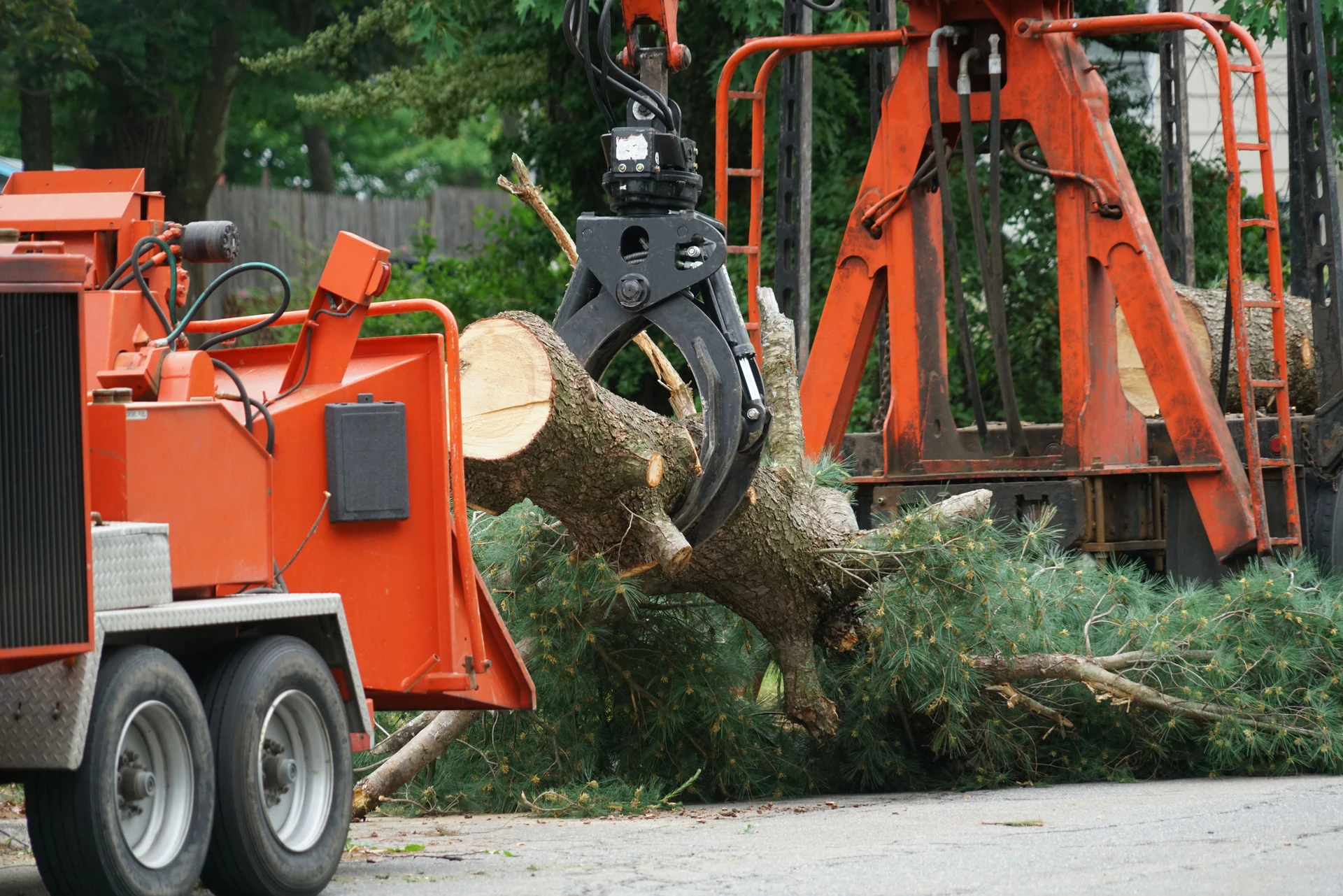
A tree that comes down at 2 a.m. does not wait for business hours, and neither does the bill. If a storm has dropped a limb on your roof or left a split trunk leaning over the driveway, the first question most homeowners ask is what emergency tree removal cost actually looks like in a place like Doylestown, PA.
This guide answers that directly. You will learn what separates emergency pricing from standard pricing, which factors raise or lower a quote, when your homeowners policy is likely to respond, what Doylestown Borough requires before a tree comes down, and the exact sequence to follow in the first hour after a tree falls.

Key Takeaways
- Emergency tree removal cost usually runs 50% to 100% above scheduled pricing.
- Tree size, lean, and access to the trunk drive most of the final quote.
- Trees on a structure cost more because crews must dismantle in sections.
- Homeowners insurance often pays when a tree damages a covered building.
- Doylestown Borough regulates removal of protected trees on private property.
- Photograph everything before a single cut is made for insurance.
Why Emergency Pricing Is Different From Standard Pricing
A scheduled removal is a planned job. The crew arrives rested, the equipment is already staged, and the arborist has walked the site in daylight.
An emergency call reverses all of that. Crews are dispatched at night, in rain or wind, to a site nobody has assessed. Nationally published cost guides such as Angi and HomeGuide consistently report that storm and after-hours work carries a meaningful premium over planned work, commonly in the range of 50% to 100% more.
That premium is not arbitrary. It reflects overtime labor, night lighting, hazard pay, higher liability exposure, and equipment that has to be pulled from another job.
Storm surge matters too. After a widespread wind event, every reputable company in Bucks County is booked at once. Demand spikes push both price and wait times upward.
What Drives the Cost of Emergency Tree Removal
Six variables account for most of the difference between a modest bill and a large one.
- Height and trunk diameter. Removal effort scales with the mass of wood that has to come down and be hauled away. A 30-foot ornamental and an 80-foot oak are not the same job.
- What the tree landed on. A trunk resting on a roof, garage, or fence has to be dismantled in controlled sections, sometimes with crane assistance. Cost to remove a tree on a house sits at the top of the range for exactly this reason.
- Proximity to power lines. Work near energized conductors requires line-clearance qualified crews and utility coordination, which adds both time and expense.
- Access. A tree in an open front yard is straightforward. A tree wedged in a narrow side yard behind a fence, with no room for a bucket truck, is not.
- Timing. Nights, weekends, and holidays trigger premium rates. Same day tree removal in Doylestown during peak storm season costs more than a Tuesday morning appointment two weeks out.
- Extras. Stump grinding, debris hauling, and log disposal are almost always separate line items. Ask whether they are included before you sign.
Comparison Table: Standard vs. Emergency Scenarios
| Scenario | Complexity | Typical relative cost | Usually covered by insurance? |
|---|---|---|---|
| Small tree down in open yard, no damage | Low | Lowest tier | Rarely |
| Medium tree down, blocking driveway | Moderate | Low to mid tier | Sometimes |
| Large tree leaning over house, not yet fallen | High | Mid to upper tier | Rarely, prevention is usually excluded |
| Tree on roof or garage | Very high | Highest tier | Usually, if a structure was damaged |
| Tree tangled in power lines | Very high, utility-led | Utility handles line clearance | Utility responsibility for the line itself |
National cost guides place standard residential removal in a broad band, with emergency and storm response landing meaningfully higher. Local quotes in Bucks County will vary with species, access, and crew availability, so treat published national figures as a starting point rather than a price.
Step by Step: What to Do in the First Hour
- Check for injuries and evacuate the affected area. Nothing else matters first.
- Treat every downed wire as live. Report downed lines and outages to PECO following their downed wire safety protocols. Do not approach the tree if wires are involved.
- Call 911 if a tree is blocking a public road or has struck an occupied structure.
- Photograph everything before anything is moved. Wide shots, close shots, interior damage, and the position of the trunk.
- Call your insurance carrier and open a claim. Ask whether an adjuster needs to inspect before removal.
- Get a licensed emergency tree service on site for an assessment. Ask for proof of general liability and workers’ compensation.
- Separate the emergency work from the cleanup. Make the tree safe now, schedule stump grinding and final cleanup later at standard rates.
- Keep every receipt and written estimate for the claim file.
Insurance: When You Pay and When the Carrier Pays
The general principle, as explained by the Insurance Information Institute’s guidance on tree damage, is that homeowners policies respond to damage to covered structures rather than to landscaping problems on their own.
That leads to two conditional rules worth memorizing:
- If the tree damaged your house, garage, fence, or another covered structure, then removal of the tree from that structure is usually part of the claim, subject to your deductible and policy sublimits.
- If the tree fell in your yard and hit nothing, then removal is typically an out-of-pocket expense, because no covered loss occurred.
Two more points that surprise homeowners:
- Preventive removal of a leaning or declining tree is generally treated as maintenance, not a covered loss. If you want that tree gone before it fails, you are paying for it.
- Neighbor trees follow the same logic in most cases. If a storm brings your neighbor’s tree onto your property, your own policy usually responds. Documented negligence, such as an obviously dead tree the owner was warned about, can shift that analysis.
Pros and Cons of Calling for Emergency Service
Pros
- Removes an active hazard to people, vehicles, and the structure
- Prevents secondary damage from rain entering an opened roof
- Restores access to driveways and entrances quickly
- Creates immediate documentation that supports an insurance claim
Cons
- Premium pricing compared with a scheduled appointment
- Limited ability to compare multiple quotes under time pressure
- Higher risk of encountering out-of-town storm chasers rather than an established local provider
- Cleanup and stump work often still require a second visit
Do and Don’t
Do
- Verify liability and workers’ compensation coverage in writing
- Ask for a written scope that lists what is and is not included
- Confirm who hauls the wood and who grinds the stump
- Ask whether the company can bill your insurer directly
- Check that the crew includes or is supervised by a certified arborist using a proper vetting checklist
Don’t
- Don’t climb on or cut a tree under tension. Storm-damaged wood springs.
- Don’t pay a large deposit in cash to a crew that knocked on your door
- Don’t remove the tree before your adjuster has seen it, unless safety requires it
- Don’t accept a verbal quote for a job that involves a structure
- Don’t hire based on price alone when power lines are anywhere in the picture
A Doylestown-Specific Wrinkle: The Tree Removal Ordinance
Pennsylvania leaves tree rules to municipalities, and Doylestown Borough has its own. The Borough requires a tree removal permit for protected trees on private property, defined by trunk diameter measured at breast height, with a modest application fee. Applications go to the Doylestown Borough Shade Tree Commission for review on a set schedule.
That review timeline is workable for planned removals and obviously impractical during an actual emergency, which is why the ordinance contains exemptions. Before assuming your situation qualifies, confirm directly with the Borough’s Department of Building and Zoning. Doylestown Township and surrounding Bucks County municipalities each maintain separate rules, so verify based on your exact address.
Species note: The Pennsylvania Department of Conservation and Natural Resources has documented the spread of emerald ash borer across the state. Standing dead ash are brittle and unpredictable, which raises both the risk and the price of removing them once they fail.
Real world scenario;
A homeowner off Route 611 has a mature silver maple about 20 feet from the house. During a summer thunderstorm, roughly a third of the canopy tears out and lands across the back corner of the roof.
The homeowner photographs the damage, calls the carrier, and books an emergency crew that night to lift the failed section off the roof and tarp the opening. That first visit is priced at emergency rates because it happens after dark, over a structure, with a rigging setup.
The remaining trunk is sound but now badly unbalanced. Rather than paying premium rates to finish everything at midnight, the homeowner schedules the full removal and stump grinding for the following week at standard pricing. The emergency portion goes into the insurance claim alongside the roof repair. The scheduled portion is paid out of pocket.
The lesson is the one worth taking away from this entire guide: pay emergency rates only for the part of the job that is genuinely an emergency.
Quick Answers:
How much does emergency tree removal cost compared with a scheduled job?
A: Expect a premium of roughly 50% to 100% over standard pricing, with the largest gaps on night, weekend, and holiday calls.
What is the tree removal cost per tree in Bucks County?
A: There is no flat per-tree rate. Quotes are built from height, diameter, access, proximity to structures, and disposal, so two similar-looking trees can price very differently.
Does homeowners insurance cover fallen tree removal cost in PA?
A: Usually only when the tree damaged a covered structure. A tree that falls in an open yard without hitting anything is typically the homeowner’s expense.
Should I remove the tree before the adjuster arrives?
A: Only if it is unsafe to wait. Otherwise, document thoroughly and ask your carrier whether an inspection is required first.
Who handles a tree tangled in power lines?
A: The utility. Report it to PECO and stay clear. A private tree service cannot legally or safely work on energized lines.
Do I need a permit for emergency tree removal in Doylestown?
A: Doylestown Borough regulates removal of protected trees and provides for exemptions. Confirm your specific situation with the Borough’s Building and Zoning department.
Is stump grinding included in an emergency quote?
A: Usually not. It is almost always a separate line item, and it is often cheaper to schedule it later.
How do I find a legitimate emergency tree service near me after a storm?
A: Look for local address, verifiable insurance certificates, certified arborist credentials, and a written scope. Be cautious with unsolicited door-to-door crews.
Can I lower my cost by keeping the wood?
A: Sometimes. Waiving haul-away and keeping logs on site can reduce disposal charges. Ask during the estimate.
Glossary of Terms
- DBH (Diameter at Breast Height): The trunk diameter measured about 4.5 feet above the ground. Municipal ordinances, including Doylestown’s, use it to define which trees are protected.
- Sectional dismantling: Taking a tree down in controlled pieces using ropes and rigging instead of felling it in one piece. Required whenever there is no safe drop zone.
- Hazard tree: A tree with a structural defect, decay, or lean that makes failure likely in a way that could injure people or damage property.
- Line clearance: Tree work performed near energized utility conductors, which requires specially qualified crews and coordination with the utility.

Conclusion
Emergency tree removal cost is driven by three things you can actually reason about: how big the tree is, how hard it is to reach safely, and whether it hit something that matters. Everything else, from after-hours premiums to stump grinding, layers on top of that foundation.
The homeowners who spend the least are not the ones who find the cheapest crew at midnight. They are the ones who make the site safe first, document before they cut, split emergency work from scheduled cleanup, and confirm insurance and permit questions before the invoice arrives.
If you have a damaged, leaning, or fallen tree on your property right now, contact our local arborists for an on-site assessment and a written estimate. If the tree is near power lines, call the utility first. Get the hazard assessed today rather than after the next storm.
